
Searching Clay County Criminal Dockets
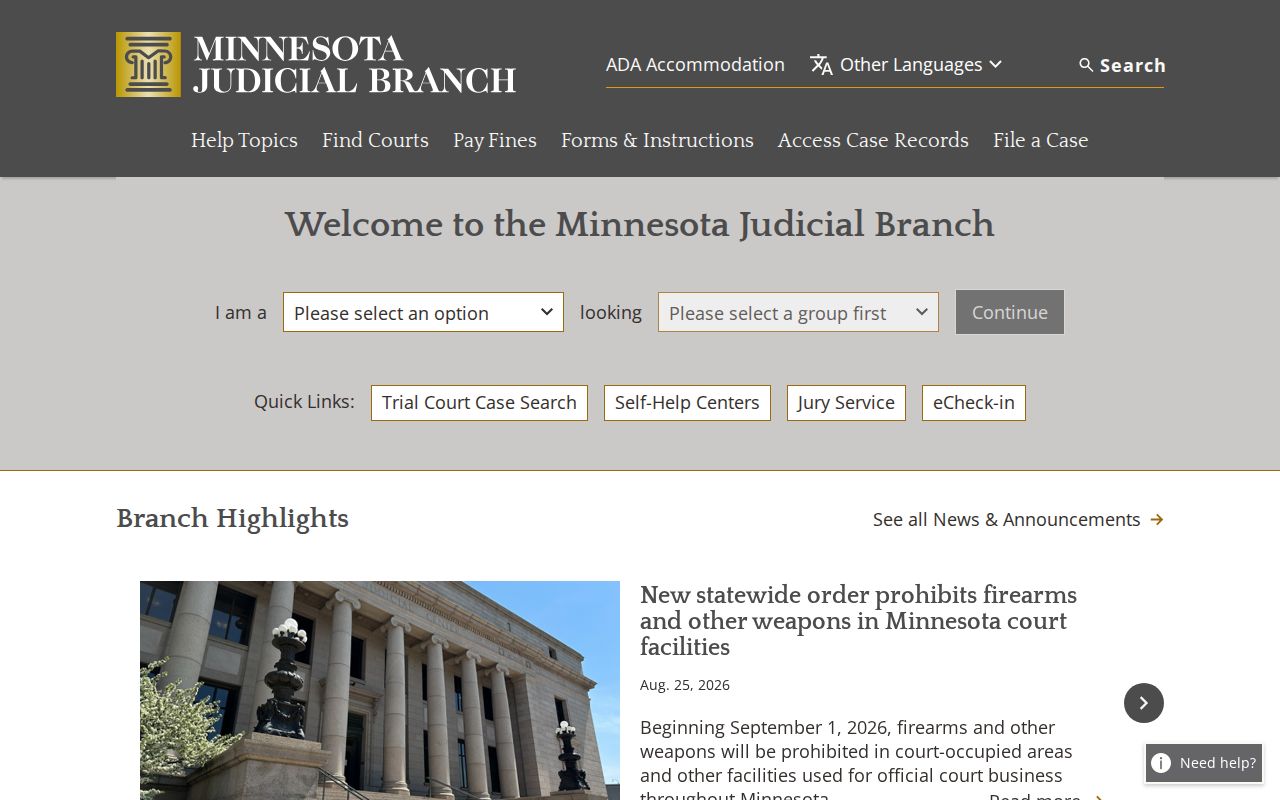
Minnesota Court Records Online, known as MCRO is where a Clay criminal case lookup starts. Pick Case Search. Accept the terms, choose the Criminal category, then select Clay under the specific-county location option. Searches run by person or business name, full case number, citation number, or attorney. From the results, open Case Details or the Register of Actions, which is Minnesota's chronological record of case activity. A full identifier works best. Enter the complete number in Case Number or Citation Number mode. Leading zeroes and dashes are fine; spaces are not. Clay MNCIS numbers follow a county prefix plus case-type format like 14-CR-26-2384, which is only a format sample and not a live record. A citation number is its own identifier. Treat it separately from the case number.
- Open MCRO Case Search and accept the portal terms.
- Select Criminal and narrow Court Locations to Clay when a county result is needed.
- Use the complete case number, citation number, name, or attorney path that fits the available information.
- Open the matching Case Details record and read the labeled events, hearings, and disposition entries.
- Ask Clay County Court Administration for a certified copy or help with a record that is unavailable remotely.
Note: MCRO is a free public lookup. It is not a certified record, and it cannot schedule hearings, accept fines, or issue court copies.
Clay Criminal Case Numbers and MCRO Limits
Name searches have one big limit. Per MCRO, a pending criminal case with no conviction cannot be found by defendant name. A dismissed or continued-for-dismissal matter may still count as pending under that rule. When a known pending Clay criminal docket does not appear, try a complete case number, a citation number, or the attorney search path instead. An empty result alone proves nothing about whether a Clay criminal case exists. Exact spelling is the default. Drop the middle name or swap in an initial. That catches variations. A wildcard works only after two characters. The Sounds Like option cannot pair with one. Date of birth and filing-date fields can narrow results, but a wrong date range can bury a Clay County criminal docket entirely. Case Status is just a filter. Active and Inactive say nothing about guilt or innocence. They also say nothing about whether a record is public or private. MCRO Document Search requires a complete Clay case number rather than a name. It can pull public documents tied to that Clay criminal case. Documents filed on or after July 1, 2015 are generally the strongest group available remotely. They remain subject to the access rules and any document-level limits.
| MCRO path | Best use for a Clay criminal docket |
|---|---|
| Case Number | Complete Clay case number, with the county and criminal case-type parts intact. |
| Citation Number | A complete citation identifier when it is distinct from the court case number. |
| Name or Attorney | A public result search, subject to the pending-criminal name limitation and portal filters. |
| Hearing Search | A scheduled setting by name, case number, attorney, judicial officer, date, category, and county. |
Inside a Clay County Criminal Docket
Case Details may hold an Overview and Case Information. It covers case number, filing date, case type, court location, judicial officer, status, citation number, flags, and related cases. The Register of Actions then lists dated Case Events and Hearings. Criminal records can add sections for Charges, Warrants, Interim Conditions, Bond or Bail Activity, Dispositions, and Financial Information. Those sections appear where the fields are public and populated. Read the labels with care. A charge is an accusation, never a conviction. A warrant-related field does not itself prove a warrant is active now. Interim Conditions and bond activity stand apart from any final disposition. Match the exact court label and date. Do not stretch a short docket phrase into a larger conclusion. Financial Information may list an amount. MCRO takes no payment.
| Case number | The court identifier, such as the Clay format 14-CR-26-2384, used for exact Case and Document searches. |
|---|---|
| Charges | Accusations listed by the court. They are not convictions. |
| Hearings and events | Dated settings and procedural entries in the Register of Actions. |
| Bond or interim conditions | Publicly displayed pre-disposition activity, where the record contains it. |
| Disposition | The court's labeled resolution. A dismissal, plea, verdict, and sentence are distinct events. |
Clay Criminal Docket Fields Need Exact Labels
The Register of Actions is a procedural record, so its language is compressed. "Disposition" marks a result the court entered. "Case Event" covers a dated filing, order, or system event. "Hearing" means a scheduled court event. "Case Assignment" holds assignment or venue details. A related case is only a cross-reference in the court file, not a license to merge facts across different people or matters. A Clay criminal docket may list an arraignment, first appearance, initial appearance under Rule 8, omnibus hearing, pre-trial, motion hearing, court trial, review hearing, probation-violation hearing, settlement conference, or intermediate disposition hearing. These are setting labels. They state an event's purpose without saying what happened there. A later Register of Actions entry can supply that context. So can the exact disposition label.
- Charge
- A criminal accusation entered in the case record.
- Disposition
- The court-labeled resolution for an event or charge, read with its date.
- Warrant
- A warrant-related section or entry, if displayed; the label alone should not be treated as a present-status confirmation.
- Register of Actions
- The chronological public case-activity record that functions as Minnesota's docket sheet.
How a Criminal Case Moves
No single script governs a Clay criminal case. Still, the docket usually records an initial filing, assignment, a first appearance or arraignment, pretrial work, a plea or trial path, and a disposition. Bond activity, interim conditions, motions, an omnibus hearing, review hearings, a probation-violation setting, sentencing, or later financial events may appear too. Each stage gets its own entry as it happens.
Docket flow: Filing › Arraignment › Pretrial › Plea or Trial › Disposition › Sentencing
Do not treat an event sequence as a forecast. Calendar settings move, and an open status says nothing about the merits. For an upcoming Clay criminal hearing, the daily calendar and MCRO Hearing Search help find a public setting; the notice and Court Administration confirm it.
Clay Criminal Hearing Labels and Daily Calendar
The daily calendar is Clay's own posting. It shows hearings, not the whole criminal docket. Each row carries a Hearing Location, Hearing Date, Time, Judicial Officer, Hearing Type, Connection Type, and Case Number. Business-day posting starts at 7 a.m. Updates come hourly. Even so, the court itself cautions that the online calendar is incomplete. The printed calendars posted outside Clay courtrooms and in public lobbies are described as the most current.
MCRO's Hearing Search gives a second way in. You can search by name, case number, judicial officer, or attorney, then narrow by date, category, and county. Treat a calendar row as a pointer to a setting only. The Register of Actions and the hearing notice remain the authoritative sources for what a case number actually requires.
One caution on the Connection Type column. It records how a hearing is listed, nothing more. The hearing notice decides whether you must appear remotely or in person for that setting.
Courts That Hold Criminal Dockets
Clay County District Court holds the criminal dockets for this county. It sits in Minnesota's Seventh Judicial District. The state runs one unified District Court system at the trial level. There is no separate city criminal court here for the profiled communities. A city name on a case does not create its own criminal-docket jurisdiction. For records and operations questions, the local Court Administration office is the contact for the District Court.
The court's criminal work covers adult matters, petty misdemeanors, and traffic cases filed in court. Other trial-level categories fit here too. Conciliation runs through District Court too. Police, parking, ordinance, and administrative records stay with the city unless a matter was filed as a state court case. Federal criminal charges travel a different road entirely. They go through the District of Minnesota system rather than MCRO or any Clay criminal docket.
Clay Criminal Dockets Beyond Moorhead
Most non-felony adult offenses inside the city go through Moorhead's City Prosecutor. That office handles the city's listed ordinances. Those include petty misdemeanors, misdemeanors, some gross misdemeanors, and the specified non-felony traffic and DWI-related matters. Its prosecutors then appear in Clay County District Court. So a Moorhead case can land on a county District Court criminal docket instead of a separate municipal record.
Who holds the record depends on what the matter is. A Moorhead police report sits with the police records unit unless it grew into a filed court case. Some matters never reach state court. A parking citation or ordinance notice may stay a city record. After a state criminal case is filed, Clay County Court Administration is the right source. It provides certified copies. Court records and police records serve different purposes. Their contents can differ.
Sealed Dockets and Public Access
Court records in Minnesota start out open. The Rules of Public Access presume access unless a rule, a statute, or a court order makes a record nonpublic. Rule 8, subdivision 2 narrows remote access. You can see more at the courthouse than online. For public criminal documents filed on or after July 1, 2015, MCRO usually offers broad access. Its listed exceptions and document-level limits still apply. Older, non-electronic, sealed, expunged, destroyed, or restricted records may return incomplete results. Some return nothing at all.
A missing Clay criminal docket does not mean sealed. First recheck the case number, spelling, county, date range, and category. Clay County Court Administration can walk you through courthouse inspection, copies, and certification. The office can also explain the process for anything unavailable remotely. A named party in a confidential but unsealed case can verify identity with the office. Getting confidential or sealed material released may require the Minnesota access-request process and a court order.
Public-access rules: Rules of Public Access Rules 2, 4, and 8 set the presumption of access, case-record categories, and remote-access limits.
Minn. Stat. §13.84 protects specified court-services data, including treatment and evaluation information.
Minn. Stat. §609A.01 addresses expungement relief and limits disclosure under the applicable order and statute.
Clay Criminal Records and Specialty Programs
Minnesota's treatment-court directory lists Clay-Becker Treatment Court and a Clay County DWI Court. Clay County's own public information also describes Drug Court and Domestic Violence Court. A public tie can surface on the Clay criminal docket. It may appear as a case event, review, referral, disposition, or sentencing entry. But clinical records, treatment details, and participant information are not presumed public. A program label proves neither eligibility nor completion.
The directory offers context for Clay criminal dockets. It names no one enrolled.
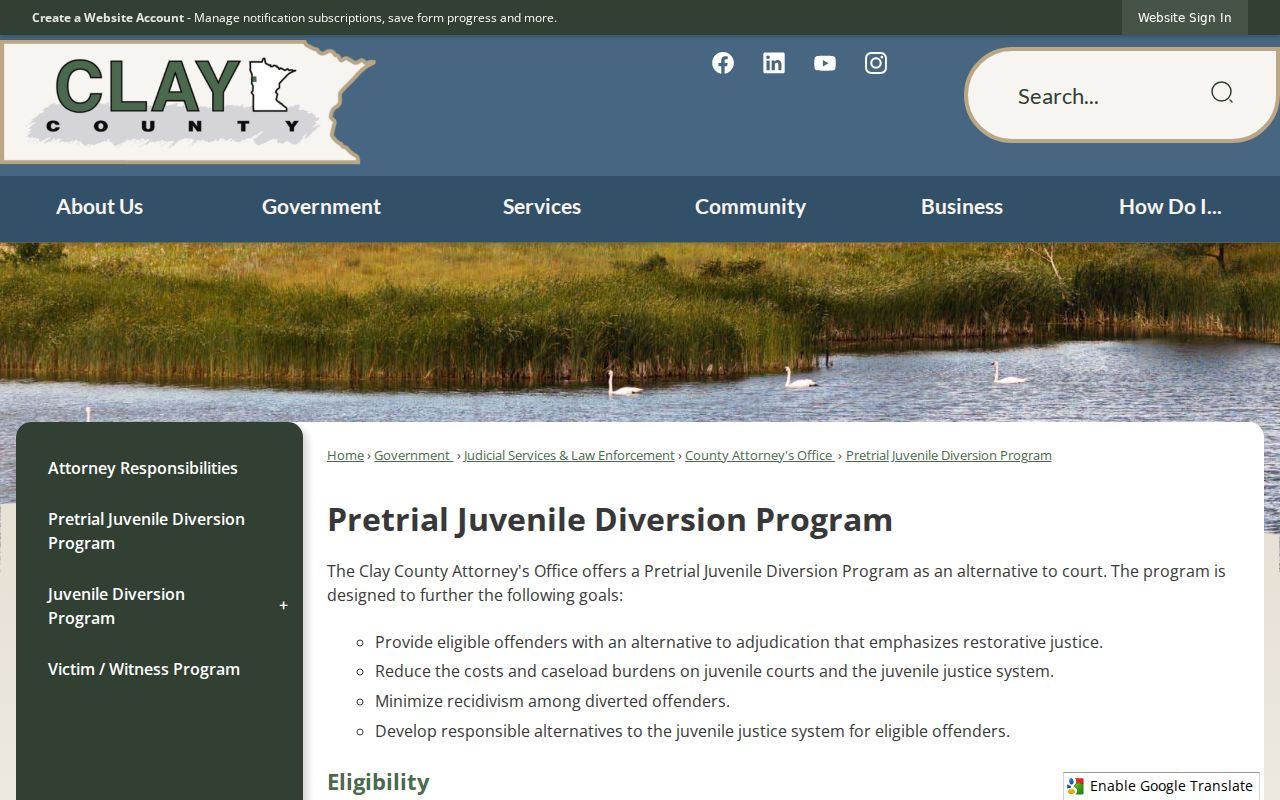
The listing helps you tell a specialty-court reference apart from the underlying case record. That record still follows the ordinary public-access rules. Clay County's juvenile diversion program offers first-time juvenile offenders an alternative to court. Finish it, the county says, and the citation can be dismissed. Then no court record shows the juvenile committed the offense. Eligibility is not automatic. Juvenile names and case details should never be guessed from public criminal search results.
The county diversion page adds context to Clay criminal records. But a diversion program is not itself an ordinary public docket.
For a public filed case, copy the Register of Actions label exactly. For a restricted juvenile or treatment-related record, ask Clay County Court Administration which access route is open to you.