
Getting Clay County Court Records
Clay County Court Administration is the local office for records held by Clay County District Court. That is where certified copies come from. Start with MCRO when you only need to identify a case or view a public document that is in scope. Go to the courthouse counter when you want to inspect a file, order a certified or exemplified copy, reach an older off-site file, or ask what is available remotely. Options go well beyond one web search. Case and document access, counter service, mail, phone confirmation, and electronic filing each have their own route into a Clay County court record.
- Find the court file number in MCRO Case Search, or collect exact names, case type, approximate filing date, and citation information.
- Name the item sought, such as a Register of Actions, complaint, order, judgment, disposition, transcript, or a particular filed document.
- Choose the access route: MCRO for available public material; Clay County Court Administration in person; the statewide request form or letter by mail; or eFS when that route applies.
- Ask Clay County Court Administration at 218-227-7040 to confirm the current routing, cost, and whether the record is public, off-site, or restricted.
- Request plain, certified, exemplified, or combined certification only after confirming the needed copy type and payment method.
Mail requests go out on the statewide form or in a plain letter. Clay posts no separate copy-request form of its own. Include the case number and the specific document. Add the copy type, return details, and payment if a fee applies. A party to a case can file a request through eFS. Anyone who is not a party should ask for an administrative court-file number first. The published fax number is 218-233-3119. Confirm that fax works for your particular request before sending anything.
Clay County Court Record Search Online
Two tools make up the online side of a Clay County court record search. MCRO Document Search is free. It shows public documents in scope, but only when you already hold a complete court file number. It cannot hunt for a case by name. For that, Case Search returns the case shell and the Register of Actions. Document Search then pulls whatever public documents exist. Keep one limit in mind. A watermark does not certify an MCRO document. A record that must be certified has to come from Clay County Court Administration.
Online access is a convenience, not a guarantee. Older paper files, items not filed electronically, and records under remote-access limits may sit only at the courthouse. So a stalled search does not mean the record is gone. First recheck the number. Then recheck the spelling, the court county, the case type, and the date range. Ask the Clay records office about inspection or a copy request before concluding anything.
The official copy-request routes page lays out each way to order copies. Every route ends in a copy of a Clay County court record.
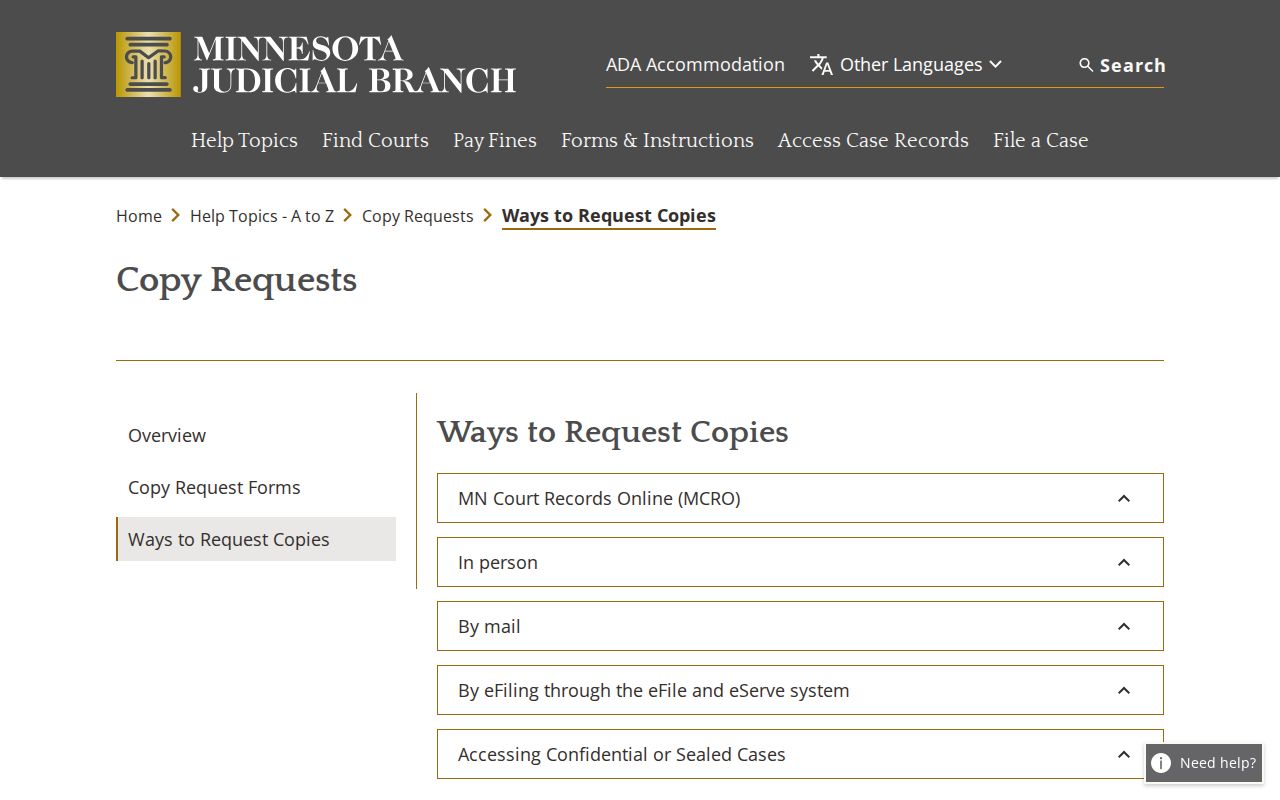
The official copy-request source shows why an MCRO result and a Clay County court record request are related but separate steps. Finding a document online is one thing. Ordering an official Clay County copy is another.
Court Record Types
Clay County Court Administration keeps the state District Court file, not every paper tied to a dispute or incident. A court file can hold a public Register of Actions, filings, orders, judgment details, and hearing information. What is actually inside depends on the case type and the public-access rules. A police report, municipal parking file, City Council minutes, real-estate record, birth record, immigration record, or Recognition of Parentage form does not become a Clay court record just because it relates to a person or event.
- Case record and Register of Actions: the filed case identity and chronological public events.
- Public filed documents: pleadings, orders, and other in-scope documents located by complete case number.
- Judgment material: judgment details, satisfactions, and a transcript of judgment where applicable.
- Hearing material: settings, calendar fields, and court-record entries, distinct from a live calendar row.
- Certified or exemplified copies: official copies obtained from Court Administration rather than ordinary downloads.
For a matter that started with the city, separate the record layers first. A Moorhead parking ticket can go through a city payment channel. A police report stays with the police records unit. A state case filed in Clay County belongs with District Court. That routing keeps a Clay County request from landing at the wrong office.
Clay County Court Record Request Details
The current Minnesota Judicial Branch Copy Request Form asks for requester contact and delivery details. It also wants case category, court file number, parties if known, and a precise description of the document. Each document row needs a name or description. Add the date or index number, copy type, quantity, and cost. A precise request helps the court avoid a costly or incomplete search.
Delivery options on the form include U.S. mail and pickup. Fax works for plain non-confidential copies. So does email, and other delivery is possible with a prepaid shipping label. Send the completed Clay request and confirmed payment to Clay County Court Administration. State guidance says most in-person requests can be same day. An off-site file may not be. That is a timing issue, not a sign the record is unavailable.
Note: Ask about scan, report, fax, and archive charges first. Approve a large Clay County court record request only after that.
Inside a Clay County Court Record
A Clay County court record often opens with Case Information and the Register of Actions. The record is more than a document download. Its fields can place an event in time. They also identify the court location and separate a hearing from a final outcome. Not every category is populated, public, or remotely accessible. Read with care: a charge is not a conviction. A case-status field is not a finding on the merits. A financial entry is not a payment receipt.
| Case number | The court file identifier used for exact search and document retrieval. |
|---|---|
| Case information | Case type, filing date, venue, judicial officer, status, flags, citation number, and related cases where available. |
| Register of Actions | Chronological case events, filings, orders, and system entries. |
| Hearings and dispositions | Scheduled events and court-labeled outcomes that should be read exactly as displayed. |
| Financial and judgment fields | Amounts or judgment information where public; neither makes an MCRO download official. |
Transcripts sit on their own request track. Name the document precisely when you ask for one. Clay's fee page prices a transcript of judgment docketed or issued at $40. Request the entire file, though, and you may draw report, scanning, or other fees, which is why an itemized ask usually works better than a vague request for everything.
Fees and Certified Copies
Copies come in three grades. A plain copy has no court seal. A certified copy carries the court's certification for official use. An exemplified copy adds verification from a judicial officer and the court administrator. Clay's fee page also keeps document-copy fees apart from filing fees. The difference matters. A conciliation filing fee or civil first-paper fee is not the cost of getting an existing Clay County court record.
| Clay County record item | Published fee |
|---|---|
| Relevant uncertified copy, printout, scan, or screen-print line | $0 |
| Certified copy of a civil or criminal instrument | $14 |
| Exemplified and uncertified copy | $14 |
| Exemplified and certified copy | $28 |
| Scanning or fax service | $25 per 50 pages or part |
| Case-management report, 1 to 50 pages | $5 |
Make checks payable to District Court Administrator. Fees can drop, too. The fee page notes they may be reduced or waived in appropriate circumstances. Watch one item, though: a $5-per-name judgment-search line sits next to a $55 base calculation, so confirm that charge directly with the court before relying on either figure.
Clay County Court Administration
Clay County Courthouse, second floor
807 North 11th Street, Moorhead, MN 56560
218-227-7040
Clay County Court Record Filing Route
Filing a document and searching public records are two different chores in Clay County. For filing and service, Minnesota eFile & eServe is the system. It will not unseal anything, hand you a certified copy, or stand in for MCRO. A party to a case can file a copy request through eFS in an existing matter. Anyone outside the case should get the administrative file number from Court Administration first.
Most attorneys, government filers, and guardians ad litem must file electronically. Self-represented users may use it too. Criminal and juvenile charging documents carry stated exceptions. And the January 2024 change to eFS email access is one more reason to sort out early whether your task is eFiling, public document access, or a plain Clay County court record copy request.
The official Minnesota eFile & eServe page describes the system in full.
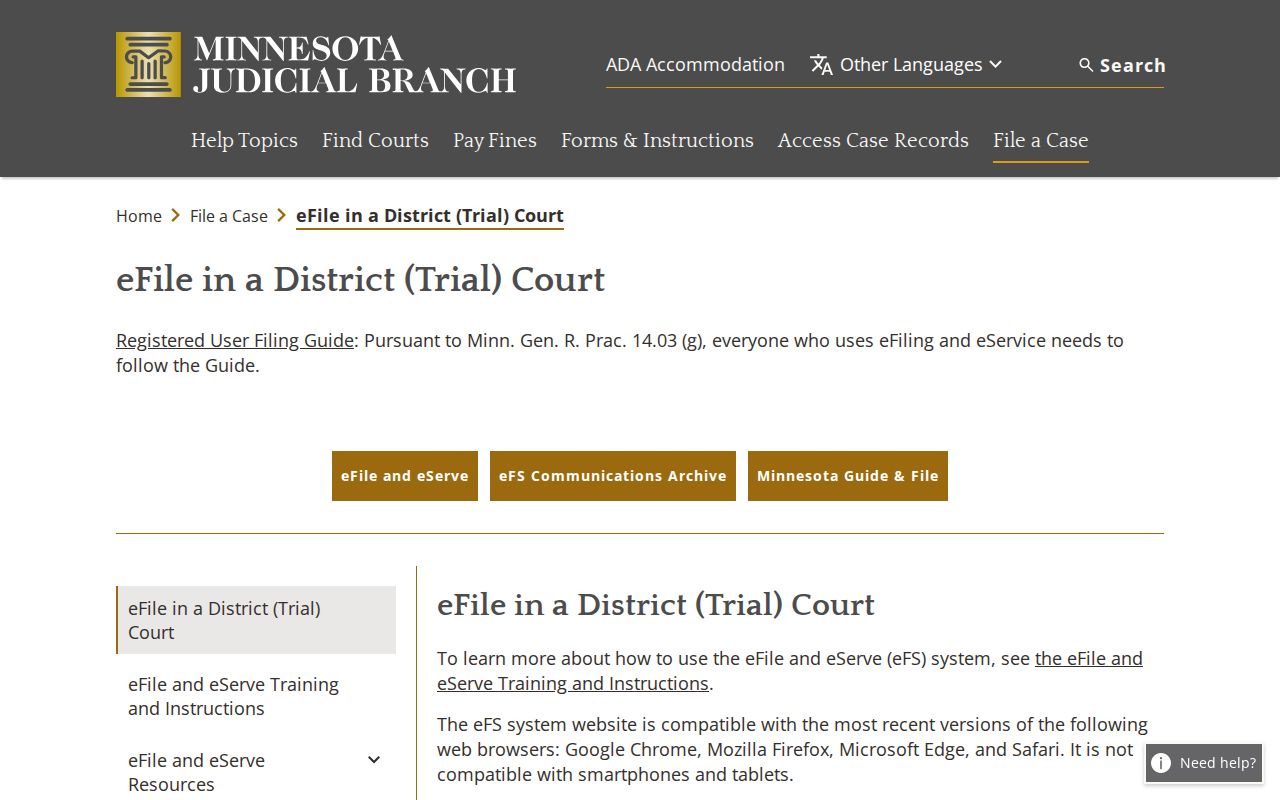
The eFS resource shows the filing system that runs alongside a Clay County court record search, never inside it. Filing and lookup stay separate.
Clay County Court Record Availability
What you can reach from home depends on the record's age and case type. MCRO offers broad public access to civil and criminal documents filed on or after July 1, 2015, within published limits. July 2005 through June 2015 is thinner. You get court-prepared judgments, orders, opinions, and notices there, but only where the case was public and remotely accessible. Expect little online before July 2005. Clay County Court Administration handles older-record questions. Family and post-adjudication paternity materials have a narrower remote set as well. Some case types never reach MCRO at all. Public civil commitment, domestic abuse, harassment, delinquency felony 16+, and CHIPS documents are unavailable online. That does not close the courthouse door. It shows the right starting point. Begin a Clay County court record request with the correct case type and the applicable court rule.
Clay County Court Record Custodians
The right custodian depends on the kind of record. Clay County Court Administration holds the District Court case file and the public Register of Actions. It also holds court-generated material and the copy-certification service. The Minnesota Judicial Branch runs the statewide layer, with MCRO for public searching and eFS for filing. The Court Payment Center answers eligible payment questions. It is not the Clay County court-record custodian, though. Ask the right office first. Your request will not get routed as a payment or filing question. City offices keep their own records. Moorhead police records, city parking files, Dilworth ordinance material, Barnesville meeting records, Hawley code information, and Glyndon administrative records may explain a local event. They are not the court file unless a state matter was filed. So sort the level first. Once a case sits in District Court, a Clay County court record request belongs with Court Administration. Municipal records requests should go to the particular city office.
Sealed Records and Public Access
Minnesota court records carry a presumption of public access. The Minnesota Rules of Public Access to Records of the Judicial Branch govern, along with any rule, statute, or court order that applies. This is not simply the state's general government-records law. Case-specific authority controls what opens or closes. Court Administration can explain the process. It cannot give legal advice or declare a restricted record open without the required authority.
Clay access rules:
Rule 2 begins with a presumption of access to court records unless an authority restricts them.
Rule 4 identifies how accessibility is determined.
Rule 8, subdivision 2 limits some remote access even where courthouse inspection may differ.
Minn. Stat. § 609A.01 concerns expungement relief and limits disclosure under the governing authority.
A confidential or sealed record goes through CON101. State your interest there. The process also asks for the specific records and your reason for access. If a judge grants access, request copies afterward, because the order itself is not a certified copy.